
If you have squirrels in the attic this winter, don’t seal the hole yet. Closing it before the attic is confirmed empty either traps a squirrel inside or locks a mother out from her young, and in both cases you end up with a new hole, a smell, or an animal stuck in a wall. The fix that lasts runs in a set order: inspect, let the squirrels leave through a one-way door, confirm the attic is empty, and only then seal. This guide explains why the order matters and what you can safely do in the meantime.
Why squirrels pick your attic in winter
An attic is dry, out of the wind and full of insulation to nest in. Gray squirrels get in through gaps at the roofline, often where a tree branch reaches the house. Once one has chewed an opening, it uses that opening every day.
You usually hear them before you see anything. The signs to look for:
- Noise at dawn and again in late afternoon, and quiet at night. Squirrels are active in daylight. Noise after dark points more to mice or a raccoon. Our guide to scratching in the walls at night covers how to tell them apart.
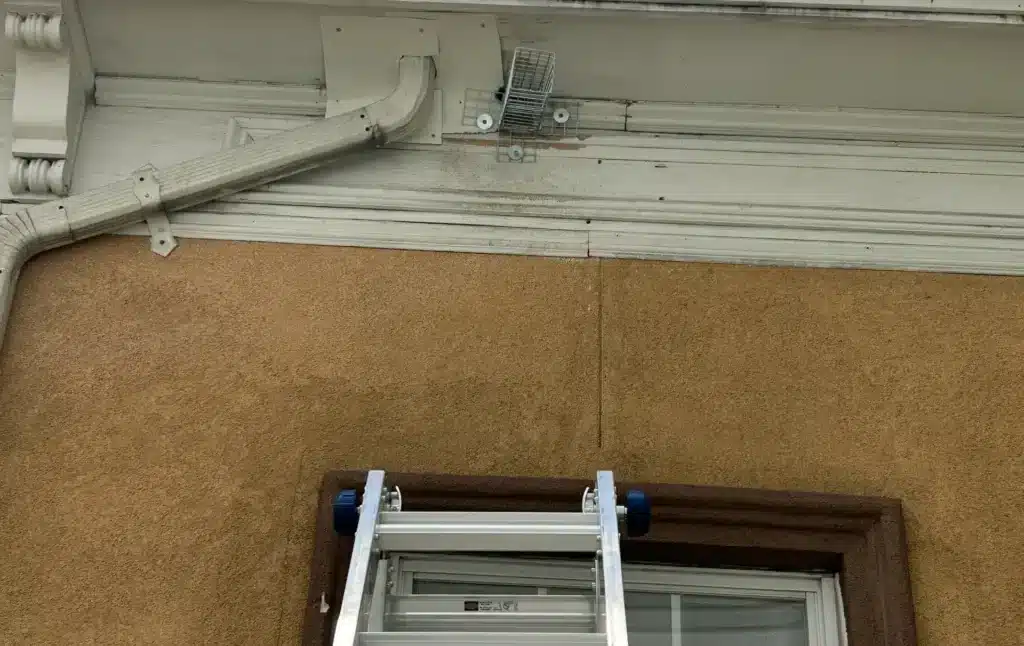
- A chewed soffit, fascia board or vent cover, often with a round hole about two inches across.
- Droppings in the attic. See what squirrel droppings look like to tell them from rat droppings.
- Shredded insulation and nesting material near the eaves.
- Squirrels running along the roof or jumping onto it from a tree.
When you find the hole, the natural reaction is to wait until the squirrel goes out, then cover it. That is the step that causes the trouble.
What happens when you seal the hole first
A sealed hole only solves the problem if nothing is inside. From the ground or a ladder you can’t know that. Here is what goes wrong.
You trap a squirrel inside
You saw one squirrel leave, but there were two. The one left inside is now shut in with no food or water. It will chew to get out, and it does not have to chew where it came in. It may open a new hole in the soffit, damage a vent, or work its way down toward the living space. Squirrels also chew electrical wiring, which is a fire risk, so a panicked squirrel loose in an attic is not something to leave for the weekend.
It falls into a wall
A squirrel moving around a closed attic can drop into a wall cavity and get stuck. You hear scratching low on a wall, often near a corner. At that point a one-way door at the roofline won’t help, because the animal can’t climb back up to it. It has to be located and removed.
You lock a mother out
Squirrels in our area have young twice a year: in late winter to early spring, and again in late summer. If you close the hole while the mother is out feeding and her babies are inside, the babies are left to die in the attic, and the mother will chew a new hole to reach them. The new hole is often bigger than the first.
The patch doesn’t hold anyway
Squirrels chew through expanding foam, wood patches and thin screen. A patch made with hardware-store materials tends to fail even when the attic really was empty, because a squirrel that has lived there will come back and test it.
That is why sealing comes last. It is the right step done at the wrong time.
Why it’s hard to know the attic is empty
The usual reasoning is “I watched it leave, so I closed the hole.” Watching helps, but it doesn’t prove much.
- There may be more than one. Seeing one squirrel go out says nothing about a second one still inside.
- Young squirrels don’t come out. Babies stay in the nest, so you won’t see them from the yard.
- There may be more than one hole. Squirrels often have a main entry and a secondary gap somewhere else on the roofline. Close one and they use the other.
- A quiet attic isn’t an empty attic. Squirrels are quiet at night and during parts of the day. A silent evening tells you nothing.
Confirming an attic is empty takes an inspection of both the attic and the roofline, a check for a nest and young, and a way for any remaining squirrel to leave without getting back in.
The order that works: out first, then sealed
This is the sequence we follow on a squirrel removal job.
- Inspect the attic and roofline. We find the main entry and any secondary gaps, and we check for young before anything is closed.
- Install a one-way door over the active hole. Squirrels leave to feed and can’t get back in.
- Trap only when a one-way door won’t work, for example when a squirrel is stuck inside a wall.
- Confirm the attic is empty.
- Seal every entry, not just the one the squirrels were using, with heavy-gauge galvanized mesh and repaired fascia or soffit.
- Clean up nesting, droppings and soiled insulation, and check for chewed wiring.
Most jobs take five to seven days from inspection to final repair, and most squirrels leave through the one-way door within the first few days. If babies are in the attic, we time the removal so the mother takes them out or they leave together.
The removal is humane. Most squirrels simply leave through the door and are kept out. When trapping is needed, we follow state wildlife rules and tell you what will happen before we start.
What you can do while you wait
You don’t have to sit on your hands until someone arrives. These steps help and don’t make the job harder.
- Note when you hear noise. Write down the time of day and which part of the ceiling. Dawn and late afternoon noise near the eaves is useful information for the inspection.
- Look from the ground. Walk around the house and look at the soffits, fascia, gable vents and the spots where one roof meets another wall. Take a photo of any hole or chewed edge. Stay off the roof.
- Look at the trees. Note any branch that reaches or hangs over the roof. Those are the branches worth trimming back once the squirrels are out.
- Keep the attic hatch closed so a squirrel can’t come down into the house.
And a short list of what not to do:
- Don’t seal, foam or screen the hole.
- Don’t count on repellents, lights or a radio. They rarely work for long. They may push a squirrel to another part of the attic, and they don’t close the hole, so it comes back.
- Don’t wait for spring. Each season squirrels enlarge the hole, which lets in water and other animals. Waiting also runs you into the late-winter breeding season, when young in the nest make the job slower.
Older homes under big trees: Tenafly, Teaneck, Englewood and Bergenfield
A squirrel problem starts at the roofline, and our Bergen County towns have a lot of roofline, because most homes there are houses, not apartment buildings. Census figures for 2020 to 2024 show that only 17.8% of housing units in Tenafly are in buildings with two or more units. In Teaneck it is 22.8%, and in Bergenfield 26.8%. The rest are mostly single-family homes, each with its own roofline, soffits and attic.
Those homes are not new. The median home was built in 1950 in Teaneck, 1954 in Bergenfield, 1958 in Tenafly and 1959 in Englewood. Wood trim that has been on a roofline for decades has had time to weather, and a tree that reaches the house gives a squirrel a way up.
The weak points we seal with mesh and metal are soffit returns, gable and ridge vents, roof-wall junctions and dormers. Our repairs and exclusions page explains the materials we use and why foam and chicken wire don’t last.
Clearview Pest Control removes squirrels and repairs entry points in Tenafly, Teaneck, Englewood and Bergenfield, and in Bayonne, Jersey City, Newark and Staten Island. If you hear squirrels in the attic, call 201-706-7437 before you close anything. We answer calls 24/7.
Frequently asked questions
Can I seal the hole if I saw the squirrel leave?
Not yet. One squirrel leaving doesn’t mean the attic is empty. There may be a second squirrel or young in the nest. Closing a squirrel in, or closing a mother out, leads to a new hole that is often bigger.
Do squirrels have babies in winter?
Squirrels in our area have young in late winter to early spring and again in late summer. That is why we check for a nest before any hole is closed, and why a winter squirrel problem is better handled now than in a couple of months.
How long does it take to get squirrels out of an attic?
Usually five to seven days from inspection to final sealing. Most squirrels leave through the one-way door within the first few days.
What is a one-way door?
It is a device fitted over the hole the squirrels are using. They can push out through it to go and feed, but they can’t get back in. Once the attic is confirmed empty, the device comes off and the hole is sealed with metal mesh.
Will the squirrels leave on their own when it warms up?
Don’t plan on it. A squirrel that has a dry attic and a working hole has no reason to move, and each season it makes the hole larger.
I hear scratching low in a wall, not in the ceiling. Is that a squirrel?
It can be. A squirrel can fall from the attic into a wall cavity and get stuck. It needs to be located and removed, and then the attic gap it came from is sealed.