
Scratching in the walls at night is most often mice or rats. Squirrels are busiest at dawn and late afternoon, and a raccoon sounds heavy and slow, more like something walking than something scratching. When you hear it, where in the house it is, and how heavy it sounds will usually narrow the animal down before anyone opens a wall. This guide walks through each one, what to check tomorrow morning, and what not to do in the meantime.
What the sound is telling you
Three questions sort most noises in a wall or ceiling:
- When do you hear it? After dark and through the night points to mice, rats or a raccoon. Just after sunrise and again in late afternoon, with quiet nights, points to squirrels.
- How heavy is it? Light, quick scratching or pattering is a small animal. Thumping, dragging or slow walking is a large one.
- Where is it? Low in the wall, behind the kitchen or along the basement ceiling is rodent territory. Up at the roofline, in the attic or above a top-floor ceiling is where squirrels and raccoons get in.
| Animal | When you hear it | What it sounds like | Where |
|---|---|---|---|
| Mice | After dark | Light scratching, quick pattering, gnawing | Wall voids, ceilings, behind appliances |
| Rats | After dark | Louder gnawing and scurrying | Basement, low walls, between floors |
| Squirrels | Dawn and late afternoon | Fast running, rolling, scratching | Attic, eaves, sometimes inside a wall |
| Raccoons | After dark | Heavy thumping, dragging, walking | Attic, chimney, garage ceiling |
The table is a starting point. The sections below give the other signs that confirm it.
Mice and rats: light scratching after dark
If the noise starts once the house goes quiet and it sounds small, think rodents first. Rodents move indoors as the weather turns cold, which is why these noises often start in late fall.
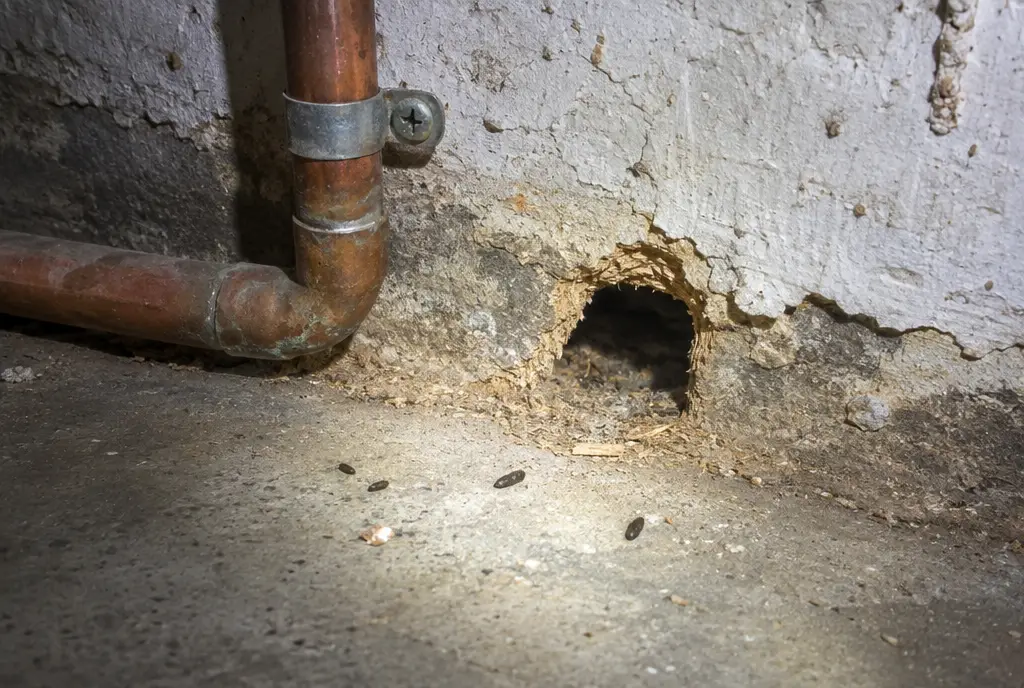
Mice climb. They nest inside the building itself: wall voids, drop ceilings, insulation and the space behind the stove or refrigerator. That is why mouse noise often seems to come from inside a kitchen wall or from the ceiling. A mouse fits through a gap about a quarter inch wide, so the opening is rarely something you would notice.
Rats come in low. Norway rats burrow under sheds, decks and stoops, then enter through foundation cracks, gaps around pipes, sewer lines and worn door sweeps. A rat needs a gap of about half an inch. Rat noise tends to be in the basement, the bottom of a wall or between floors, and the gnawing is louder.
Signs that confirm rodents:
- Droppings. Mouse droppings are the size of a grain of rice. Rat droppings are closer to a raisin.
- Where the droppings are. Kitchen cabinets and ceilings point to mice. Basement floors and the foundation line point to rats.
- Gnaw marks on food packaging, door frames or wiring.
- Greasy rub marks along walls and pipes where rats travel the same route.
Our rat and mice control page explains how we tell the two apart and why they need different plans.
Squirrels: loud at dawn, quiet at night
Squirrels keep daytime hours. The pattern is running or scratching in the ceiling just after sunrise and again in late afternoon, then nothing overnight. If your noise is strictly a night noise, a squirrel is unlikely.
Gray squirrels get into attics through gaps at the roofline, often where a tree branch reaches the house. Look from the yard for chewed soffits, fascia boards or vent covers. The hole is often round and about two inches across.
There is one case where a squirrel does sound like it is in the wall. A squirrel can fall into a wall cavity from the attic and get stuck. You hear frantic scratching low on the wall, often near a corner, and it may go on at odd hours because the animal can’t get out. That one needs a call the same day.
If you find droppings in the attic and aren’t sure whose they are, compare them with our guide to what squirrel poop looks like. More on how the job works is on our squirrel removal page.
Raccoons: heavy and slow
A raccoon doesn’t scratch so much as move furniture. The signs are heavy thumping, dragging or walking in the attic after dark.
Other signs of a raccoon:
- Torn shingles, soffits, vents or fascia, or a bent chimney cap. A raccoon is strong enough to rip its own way in.
- Droppings piled in one spot. Raccoons use a latrine.
- Tipped trash cans and muddy prints on siding or downspouts.
- Chattering or crying sounds in spring, which often means kits.
Don’t go into the attic to look for it, and don’t try to trap it yourself. Raccoons are a rabies vector species in New Jersey and New York, and a cornered one bites. Their droppings can carry raccoon roundworm, so a latrine should not be swept or vacuumed with a household vacuum. See raccoon removal for how we handle them.
Row houses, apartments and detached homes
The kind of building you live in changes the odds.
Attached and multi-unit buildings. In Jersey City, more than 85% of housing units are in buildings with two or more units, according to the Census Bureau’s American Community Survey (2020 to 2024). Bayonne’s housing is older: about 36% of its units were built before 1940. In buildings like these, and in Newark’s row houses, mice travel from home to home through shared walls and roof junctions. A noise in your wall may be coming from a problem that started next door, and treating one unit rarely ends it. If you rent, tell your landlord or building manager what you are hearing.
Detached homes with trees. Bergen County homes in Englewood, Teaneck, Tenafly and Bergenfield sit next to yards and wooded lots, and most Staten Island homes are single-family houses. That brings squirrels and raccoons to the roofline as well as mice to the foundation. Branches that reach the roof are a bridge.
What to do, and not do, before you call
You don’t need to open anything. A few notes make an inspection faster:
- Write down the time you hear the noise for two or three days. Night only, or dawn and late afternoon?
- Note the spot. Which room, which wall, high or low.
- Look for droppings in the kitchen cabinets, the basement and the attic hatch area. Don’t sweep them up. Note the size and where they are.
- Walk the outside in daylight. Look for chewed or torn spots at the roofline, gaps where pipes and cables enter, and burrows along the foundation.
- Check the trees. Any branch touching or overhanging the roof is worth mentioning.
And four things to avoid:
- Don’t seal the hole yet. Closing a gap while animals are inside shuts them in the walls. With squirrels, sealing the mother out while babies are inside leaves them to die there, and she will chew a new hole to reach them.
- Don’t put loose poison inside. A rodent that eats poison indoors often dies in a wall or under a floor. Then you have a smell for weeks and a dead animal removal job on top of the first problem.
- Don’t light a fire to drive an animal out of a chimney. Young raccoons can’t climb out.
- Don’t wait for it to leave on its own. Rodents and squirrels chew electrical wiring, and every season the opening gets larger.
What happens at an inspection
The first job is to confirm which animal it is, because the fix is different for each.
- For mice and rats, we inspect inside and out for droppings, runways, gnaw marks and burrows. We trap inside the building, use bait outside only in locked, tamper-resistant stations where it is needed, seal the entry points with materials rodents can’t chew through, and follow up to confirm activity is dropping.
- For squirrels and raccoons, we inspect the attic and roofline, find every opening and check for young. The animals leave through a one-way door or are trapped when a door won’t work. Once the space is confirmed empty, we seal the entry and clean up. Most of these jobs take five to seven days from inspection to final repair.
In every case there are two halves: getting the animals out, and closing the way in. Trapping without sealing leaves the door open for the next one. Our repairs and exclusions work covers the sealing.
Clearview Pest Control Inc. serves Bayonne, Jersey City, Newark, Englewood, Teaneck, Tenafly, Bergenfield and Staten Island. We answer calls 24/7. Call 201-706-7437 to book an inspection, and tell us when and where you hear the noise.
Scratching in the walls: FAQs
Is scratching in the walls at night always mice?
No. Mice and rats are the most common cause of light scratching after dark, but a raccoon is also active at night, and a squirrel stuck inside a wall cavity can scratch at any hour. How heavy the sound is and where it comes from help tell them apart.
Why do I only hear it at night?
Mice, rats and raccoons are active after dark, and the house is quiet enough then to hear them. If you hear the noise at dawn and late afternoon and nights are quiet, squirrels are more likely.
Can I just seal the hole I found?
Not until you know nothing is inside. Sealing animals in means they die in the wall or chew a new way out, often a bigger one. The opening gets closed after the space is confirmed empty.
The noise stopped. Does that mean the animal is gone?
Not necessarily. Animals move around a building, and a quiet few days can mean they shifted to another wall or the attic. Fresh droppings and new gnaw marks are better evidence than silence. If there was an opening, it is still there for the next animal.
I live in an apartment. Who should I call?
Tell your landlord or building manager first, in writing, with the times and places you hear the noise. Rodents move between units through shared walls and pipes, so the building usually needs to be treated as a whole. We can work with the owner or management company on the connected units and common areas.
Do you have to open the wall to find it?
Usually the inspection answers the question without it: droppings, entry points and the pattern of the noise show which animal it is and how it got in. A squirrel stuck in a wall cavity is the main exception, and we remove it with as little damage as possible.