
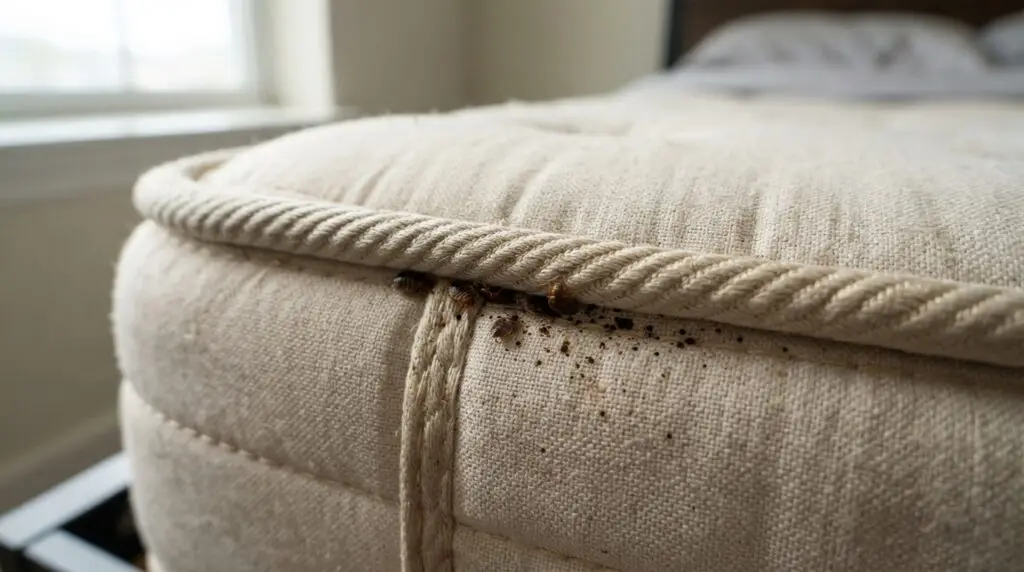

To check a hotel room for bed bugs, leave your bags in the bathroom, pull back the sheets at the pillow end of the bed, and look along the mattress seams and the edge of the headboard with your phone flashlight for dark ink-like spots, pale shed skins or the bugs themselves. It takes about five minutes. When you get home, one hot dryer cycle for your clothes does most of the rest. This guide walks through both halves of the routine, and what to do in the weeks after a trip if you live in an apartment building in Jersey City, Bayonne or Newark.
Why holiday trips bring bed bugs home
Bed bugs don’t fly or jump. They get from place to place by riding on things people carry. The University of Kentucky’s extension entomologists describe them as efficient hitchhikers that are easily carried into a home on luggage, clothing and other belongings, and they note that hotels are a particular problem because guests change constantly. (University of Kentucky, ENTFACT-636)
It has nothing to do with how clean a hotel or a home is. Bed bugs feed only on blood, so a spotless room suits them as well as a messy one.
The holidays stack the odds a little. More people travel, more rooms turn over, and more suitcases end up on beds and carpets. A guest room at a relative’s house counts too. The good news is that the same short routine works everywhere you sleep away from home.
What you are looking for
You are more likely to find signs of bed bugs than the bugs. The U.S. Environmental Protection Agency lists these signs (EPA, How to Find Bed Bugs):
- Dark spots about the size of a pen dot. This is bed bug excrement. On fabric it can bleed like a marker would.
- Rusty or reddish stains on sheets or the mattress, left when a bug was crushed.
- Tiny pale eggs and eggshells, about one millimeter long, and the pale yellow skins young bed bugs shed as they grow.
- Live bed bugs. An adult is about 3/16 of an inch long, flat, oval and reddish-brown. Think of an apple seed.
The EPA also gives a useful rule for where they hide: if a crack will hold the edge of a credit card, it could hide a bed bug.
The five-minute hotel room check
Do this before you unpack, and before anything goes on the bed.
- Park your bags in the bathroom. Put luggage in the tub or on the tile floor while you look around. It is a hard, bare surface a long way from the bed.
- Pull back the bedding at the pillow end. Lift the corners of the fitted sheet and look at the mattress seams, piping and tag. The head of the bed is where signs show up most often.
- Look at the box spring and the headboard edge. Shine your phone flashlight along the top of the box spring and the gap where the headboard meets the wall. Headboards are a common hiding place in hotel rooms. Don’t try to take one off the wall. They are heavy, and looking along the edge is enough for a guest.
- Check the luggage rack. Look at the straps and the joints of the frame. The EPA lists this as a basic precaution for travelers.
- Glance at the nightstand and any soft chair next to the bed, mainly the seams and the drawer joints.
If everything is clean, unpack. If you find spots, skins or a bug, take a photo and call the front desk before you move your bags.
If you find something, and how to keep your bags safe anyway
Most hotel infestations are small. According to the University of Kentucky, the majority are limited to just a few rooms. So you don’t need to leave the hotel. Ask for another room, and ask that it not be next to, above or below the first one, because bed bugs sometimes spread to nearby rooms.
Even in a clean-looking room, a few habits cut the risk:
- Keep the suitcase off the floor and off the beds. Use the luggage rack, a desk or another hard surface.
- Keep it zipped when you aren’t using it. Take out what you need and leave the rest closed.
- Bag your worn clothes. A plastic bag for laundry keeps it separate and makes unpacking at home simpler.
- Don’t use the second bed as a shelf.
How careful to be is up to you. These steps cost nothing and take no time once they are a habit.
The unpacking routine when you get home
This is the half people skip, and it matters as much as the hotel check.
Unpack away from the bedroom
Open the suitcase in the laundry room, the bathroom, the garage or by the front door on a hard floor. Not on your bed, and not on the bedroom carpet.
Put the clothes through the dryer
Heat is what kills bed bugs. The University of Kentucky notes that a clothes dryer on medium to high heat for 10 to 20 minutes kills every life stage, eggs included, and that it works faster when the items go in dry. So clean clothes you never wore can go straight into the dryer without washing. Worn clothes can be washed and then dried on a hot cycle as usual. Carry the clothes to the machine in a bag, and throw the bag away afterward.
Deal with what can’t go in the dryer
Rutgers Cooperative Extension says small items such as shoes and books can be sealed in a plastic bag and left in a household freezer for four days. (Rutgers FS1251) Check the care instructions first, and don’t freeze anything that cold or moisture could damage.
Store the suitcase outside the bedroom
The University of Kentucky is frank that inspecting or vacuuming a suitcase is of limited use, because bed bugs are hard to spot in luggage. If you have no reason to worry, store the empty bag in a closed plastic bag or tote in a basement, garage or hall closet, not under your bed. If you were bitten on the trip or found signs in the room, treat the suitcase as suspect. Rutgers lists portable heat chambers as a way to treat items like suitcases that can’t be laundered.
The weeks after: what to watch for in an apartment building
You won’t know right away whether the routine worked, for two reasons. Bite reactions can be delayed by days or even weeks, and the University of Kentucky cites studies suggesting about 30 percent of people don’t react to bites at all. The EPA calls bites a poor indicator for the same reason. Look for the physical signs instead.
- Check your sheets and mattress seams when you change the bed for the next several weeks. You are looking for the same dark spots and pale skins.
- Consider interceptor traps. These are small plastic dishes that sit under the legs of the bed. Rutgers reports that traps under furniture legs detect bed bugs better than looking by eye, and recommends checking them every one to two weeks.
- Don’t move to the couch. Rutgers lists switching where you sleep among the things that don’t work. The bugs follow you, and now they are in two rooms.
- Skip the foggers and store-bought sprays. Rutgers lists foggers and most consumer sprays as money-wasting methods.
In a house, a bed bug problem is your problem. In an apartment building it can become the building’s. Bed bugs walk between units through gaps around pipes, outlets and baseboards. And most homes here are in shared buildings. Census figures for 2020 to 2024 show that 85.5% of housing units in Jersey City are in buildings with two or more units. In Bayonne it is 79.1%, and in Newark 76.6%. We wrote more about this in why bed bugs spread in Jersey City apartments.
So if you do find signs after a trip, act early and tell your landlord or property manager. The units beside, above and below yours may need to be checked as well. It is not an admission of anything. Catching it in one unit is far easier for everyone than chasing it through six. Our guide to who handles pests in a New Jersey apartment covers how to raise it.
When to call a professional
Call when you find a live bug, dark spotting on the mattress or box spring, or shed skins. Save a bug in a sealed bag or take a clear photo if you can, because other insects, such as carpet beetles, are easily mistaken for bed bugs.
Our bed bug treatment starts with a detailed inspection of the mattress, box spring, furniture, baseboards and outlets to find out which rooms are affected. Treatment combines heat, which raises the room to 120 to 140°F for several hours, with targeted applications in cracks and crevices. Eggs can hatch one to two weeks after the first visit, so we schedule follow-ups, typically two to three weeks later.
Clearview Pest Control treats bed bugs in Bayonne, Jersey City, Newark, Staten Island, Englewood, Teaneck, Tenafly and Bergenfield. If you came home from a trip and something doesn’t look right, call 201-706-7437 for a free inspection. We answer calls 24/7.
Frequently asked questions
Where do bed bugs hide in a hotel room?
Mostly close to the bed: mattress seams and piping, the box spring, the bed frame and behind or along the headboard. In a room with a heavier problem they can also be in the seams of chairs, drawer joints and around electrical outlets.
Should I put my suitcase in the bathtub?
The tub or the bathroom floor is a sensible place to leave it while you check the room. During your stay, keep it on the luggage rack or another hard surface, off the floor and off the beds, and keep it zipped.
Does the dryer really kill bed bugs?
Yes. The University of Kentucky notes that 10 to 20 minutes in a dryer on medium to high heat kills all life stages, and that dry items reach a lethal temperature faster.
How soon after a trip would I know I brought bed bugs home?
Not right away. Bite reactions can take days or weeks to appear, and some people never react. Check your mattress seams and sheets when you change the bed for several weeks, or use interceptor traps under the bed legs.
I found one bug after a trip. Is that an infestation?
Not necessarily, but don’t ignore it. Save it in a sealed bag or photograph it so it can be identified, check the bed seams, and have the room inspected. A small problem caught early is much easier to deal with.
I live in an apartment. Should I tell my landlord?
Yes, and early. Bed bugs move between units, so the neighboring apartments may need to be checked too. Reporting it quickly is what keeps one unit from turning into several.