Berkeley Heights sits on a ridge in Union County with the Passaic River along its northern edge, Green Brook to the east, and the Watchung Reservation inside its own borders. Roughly 13,000 people live here on wooded lots that back onto county parkland. That setting is pleasant to live in and it is the reason pest pressure here looks nothing like it does in a dense town ten miles east.
Call (201) 706-7437 to book an inspection.
Mosquitoes are the number one call here, and EEE is the reason
Most towns worry about West Nile. Berkeley Heights has had a harder conversation than that — mosquitoes trapped in the township have tested positive for Eastern equine encephalitis, and spraying has followed. EEE is rare, but it is far more serious than West Nile when it does infect someone, and New Jersey’s Department of Health publishes guidance on EEE and how it spreads.
The mosquitoes that matter here are freshwater woodland breeders, not the salt marsh species that plague the coast. They come out of very different places:
- Leaf litter and low spots on wooded lots. A ridge township has hollows that hold water for a week after rain, and under a closed tree canopy they never dry out.
- Tree holes and rot cavities in the mature oaks and maples these properties are full of. Nothing you do at ground level touches them.
- Clogged gutters under heavy canopy — the single most reliable breeding site on a Berkeley Heights house, and the one homeowners find hardest to believe.
- Tarps, boat and firewood covers, wheelbarrows, unused plant saucers in the outbuildings that come with a larger lot.
- Corrugated drain extensions and dry wells that hold a few inches at the low end.
The Union County Bureau of Mosquito Control maintains drainage ditches, sprays on a scheduled and as-needed basis, and will inspect a property when a resident reports a problem. That covers the county’s side of the line. It does not run a season-long program on your acre, which is where we come in — larvicide in the water that cannot be drained, barrier treatment on the shaded vegetation where adults rest through the day, and repeat visits from May through the first hard frost. Our approach is set out on the mosquito control page.
Ticks: the ten feet where your lawn meets the woods
The Watchung Reservation is not near Berkeley Heights. It is in Berkeley Heights — a county reservation with Lake Surprise, miles of trail, and the Deserted Village of Feltville inside the township boundary. Add the Passaic River Parkway and a great many properties that back directly onto woodland, and you have the conditions for blacklegged ticks.
The useful thing to know is that ticks are not evenly spread across a yard. They concentrate in the transition zone — roughly the first ten feet of lawn where it meets the tree line, plus leaf litter, stone walls and ground cover. Open, sunny, mown lawn is comparatively low risk. That means treatment is targeted at the edge rather than broadcast across the property, and simple landscape changes help: a three-foot mulch or gravel strip along the woodland border, leaf litter cleared back, play equipment moved into full sun.
We treat the perimeter zone in spring and again in late summer, timed to the nymph and adult stages. See tick control for how the program runs.
Wildlife arrives from parkland, not from an alley
Sharing a border with a county reservation means the wildlife here is resident rather than passing through. The calls we take most often in this part of Union County:
- Groundhogs — under sheds, decks, pool equipment pads and porch slabs. On larger properties with outbuildings this is the most common wildlife complaint, and the burrowing undermines footings.
- Squirrels — mature canopy touching rooflines gives them a bridge onto every house. See squirrel removal.
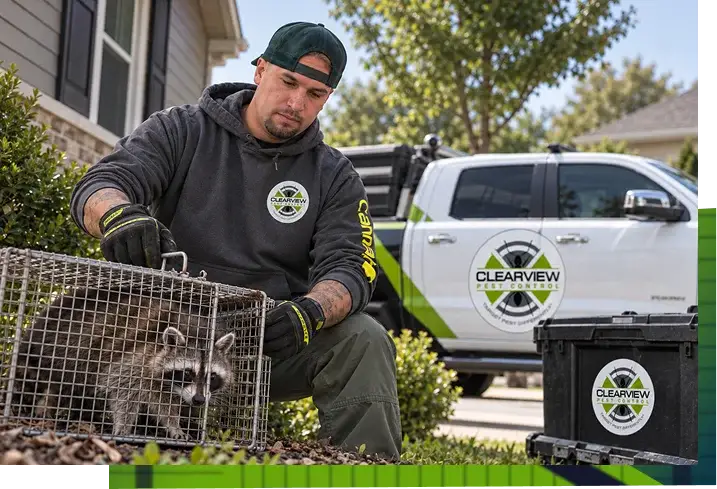
- Raccoons — attics, chimneys and the void under a low deck. Detail on raccoon control.
- Skunks and opossums — denning under decks and sheds, usually noticed by smell or by the dog.
- Moles and voles — the lawn damage that comes with a large, well-watered property backing onto woods.
The pattern on wooded suburban lots is that the entry point is almost always an outbuilding or a low deck rather than the house itself. Screening a deck perimeter properly and trenching the mesh below grade solves more of these than trapping does — which is why we quote the exclusion work alongside the removal.
What the housing stock invites
Berkeley Heights stayed largely rural until Bell Labs arrived in 1941. Most of the township was built out in the decades after, which means post-war colonials, split-levels and ranches, with a smaller stock of older houses including the Free Acres community established in 1910. That mix produces a predictable set of problems:
Carpenter ants before termites. Heavy canopy means damp shaded siding, and split-levels are full of the roof-to-wall junctions where water gets in. We find carpenter ants in wet sill plates, deck ledger boards and the framing behind failed gutters far more often than we find subterranean termites — though termites are here too, and a wood-destroying insect inspection is still worth having before a sale.
Mice, not rats. The rodent story here is the white-footed and house mouse moving in from the woodland edge as nights cool in October, not the sewer-driven Norway rat problem of the urban towns. They enter low — garage door sweeps, utility penetrations, crawl space vents — and a wooded lot delivers them to your foundation every autumn. See rodent control.
Overwintering invaders. Brown marmorated stink bugs, boxelder bugs, cluster flies and lady beetles mass on warm south and west walls through October and push in around window frames and attic vents. Nothing you spray indoors in January fixes this; the work is an exterior perimeter treatment in early autumn, before they cluster.
Commuters, and the one pest that follows them
Berkeley Heights station on NJ Transit’s Gladstone Branch runs into Hoboken, Newark Broad Street and Penn Station. Bed bugs travel on people and belongings rather than coming in from the yard, so a commuter town has a route in that a rural one does not. It is a much smaller share of our calls here than in the dense rental markets east of the county, but it is worth knowing that a clean, detached house is not immune — see bed bug control.
Frequently asked questions about pest control in Berkeley Heights
Does the county spraying mean I do not need my own mosquito treatment?
No. Union County maintains drainage and sprays on a scheduled and as-needed basis, and will inspect if you report a problem. That work stops at the property line for ongoing treatment. Your gutters, tree holes and low spots are still yours, and they are where most of the mosquitoes on your lot actually hatch.
When should tick treatment happen?
Two applications: spring for the nymphs, which are the stage most likely to transmit disease because they are small enough to go unnoticed, and late summer into autumn for adults. We treat the woodland edge and leaf litter rather than the open lawn, because that is where they actually are.
Something is burrowing under my shed. How urgent is it?
More urgent than most people assume. A groundhog burrow undermines slabs and footings, and once a den is established another animal will use it after the first one leaves. Removal plus a trenched mesh barrier around the structure is what ends it.
Are treatments safe around children, pets and vegetable gardens?
Yes. Our products are pet-friendly and we work with eco-friendly and organic options where they suit the job. Tell us where the vegetable beds, play areas and any beehives are before we start and we will work around them, and we will tell you how long to stay off treated foliage — usually until it dries.
My house backs onto the Reservation. Is there anything I can do myself?
Quite a lot. Keep a three-foot mulch or gravel strip where the lawn meets the woods, clear leaf litter back from the house, cut branches off the roofline, keep gutters clear, and move woodpiles off the ground and away from the foundation. Those five things reduce tick, rodent and wildlife pressure together.
Which other towns near here do you cover?
We work across Union County and into neighboring Chatham Township. Tell us your street when you call and we will confirm scheduling for your area.
Book an inspection in Berkeley Heights
Call (201) 706-7437. Tell us which side of the township you are on and whether your property backs onto woodland — it changes what we look at first. For everywhere else we work, see our service areas.