Fort Lee packs roughly 40,000 people into 2.87 square miles — about 13,900 to the square mile, with ten buildings over 300 feet tall and no rural land at all. That is a different pest environment from anywhere else in Bergen County, and it means most pest problems here are building problems rather than property problems. Clearview works Fort Lee from the towers on the Hudson side to the older streets west of Lemoine.
Call (201) 706-7437.
What high-rise living changes about pest control
In a house, pests come in from outside. In a twenty-story tower, most of them are already inside and moving vertically. Four features of high-rise construction account for the overwhelming majority of the calls we take here.
The trash chute and the compactor room
This is the single most important thing in the building. Every floor feeds one shaft that terminates in a warm, damp, food-rich room at the bottom. Residue coats the inside of the chute, the hopper doors rarely seal well, and the compactor room runs warm year-round. If a tower has German cockroaches, drain flies or a rodent presence, the chute and the room beneath it are the reservoir in most cases — not the apartments complaining about it.
Practical consequence: treating the complaining units and skipping the chute is money spent for a six-week reprieve. The chute needs mechanical cleaning on a schedule, not just treatment.
Vertical riser stacks
Kitchens and bathrooms are stacked to share plumbing, and the chase carrying those risers runs the full height of the building. Cockroaches use it as a heated, humid highway between floors. A complaint on 14 frequently originates on 12 or 16, and treating a single apartment displaces the population rather than removing it.
Balconies and terraces
The container-breeding mosquito does not care that you are on the ninth floor. Plant saucers, watering cans and the trays under balcony furniture hold enough water to produce a generation, and pigeons will nest on any ledge or railing left undisturbed. Balcony planters also carry ants up with the soil.
Turnover and moving day
A large tower may see several move-ins a week. Bed bugs travel on furniture and belongings, and a building with constant turnover has more opportunities in a month than a single-family street has in a year. The most cost-effective thing any Fort Lee building can do is inspect vacant units between tenancies.
Working with buildings, not just apartments
If you are a resident, we will treat your unit and tell you honestly whether the evidence points beyond your door. If it does, we would rather approach the building than take your money twice.
If you manage or own a building, a scheduled program is dramatically cheaper than reacting to complaints one at a time. That means routine service in the compactor room, trash rooms, basement, boiler room, loading area and refuse enclosure; monitoring devices mapped and numbered so an inspector can walk the site against a drawing; and a written record of every visit and finding. The EPA’s guidance on pest control for housing managers makes the same case for multi-family buildings.
New Jersey’s habitability rules also mean pest infestation is not simply a tenant’s problem in a rental building. Legal Services of New Jersey sets out what tenants are entitled to, and documentation of what was found and done protects both sides of that conversation.
The Main Street food corridor
Downtown Fort Lee has one of the densest restaurant concentrations in the county, with a large Korean commercial district running through it. Food businesses here face the standard pressures amplified by tight sites: shared party walls with residential above, limited rear yard for refuse, deliveries arriving in corrugate daily, and long operating hours that leave narrow service windows.
The recurring findings are consistent — German cockroaches arriving in cardboard, small flies breeding in floor drains and under equipment, and rodents entering through a rear service door that no longer seals. Programs for these sites run early morning or after close, with documentation kept on site for health inspections.
The rest of the borough
Not all of Fort Lee is towers. The streets west of the main corridors hold older single-family and two-family houses, and those get the problems you would expect from Bergen County housing stock: mice entering low in autumn, carpenter ants in damp framing, pavement ants in slab joints, and wildlife along the wooded edges toward the Palisades.
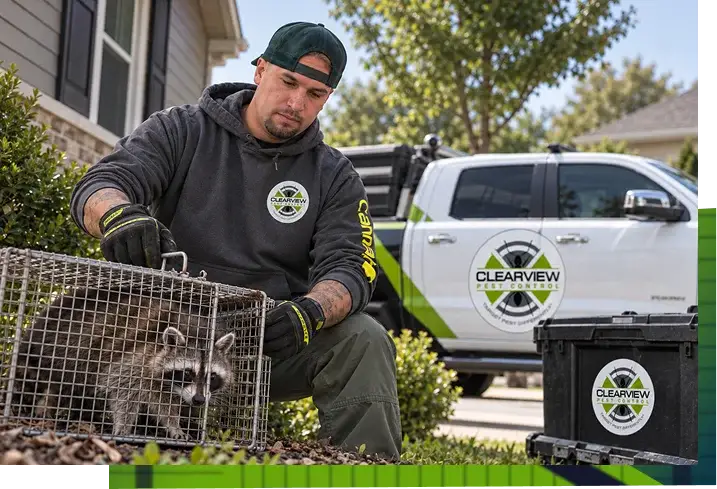
The Palisades themselves matter. The borough sits atop a 260-foot escarpment with Palisades Interstate Park along the cliff face, and that strip is a continuous wildlife corridor. Raccoons and squirrels working the eastern streets are coming from it, and the answer is exclusion on the roofline rather than trapping on repeat. New Jersey regulates how nuisance wildlife may be handled — the framework sits with NJ Fish & Wildlife.
Mosquitoes, at ground level and above it
Bergen County operates a mosquito control division that inspects on request; you can submit a mosquito inspection request at no cost. What the county cannot do is manage a courtyard, a podium deck or two hundred balconies.
For buildings, the productive work is the water nobody looks at: podium deck drains that pond at the low end, planter reservoirs in landscaped courtyards, tarps over stored furniture, and roof drainage. For residents, it is the saucer under the balcony pot. The Asian tiger mosquito biting you on a terrace hatched within a couple of hundred yards, which usually means somewhere on your own building.
Frequently asked questions about pest control in Fort Lee
I am on a high floor. How did roaches reach me?
Vertically, through the plumbing riser chase behind your kitchen and bathroom, or via the trash chute. Height is no protection at all in a stacked building — the population travels inside the structure rather than climbing the outside of it.
Management treated my apartment and they came back. Why?
Almost always because the source was elsewhere — commonly the compactor room or a neighboring stack. Single-unit treatment in a tower suppresses without eliminating. We will say plainly when that is what we are seeing.
Can you service a building outside business hours?
Yes. Early morning, after close and overnight are all routine for us, which matters for the restaurants downtown and for common areas in occupied buildings. Tell us your window when you call.
There are pigeons nesting on my balcony railing.
That is a building-wide issue rather than an individual one, because a colony will simply move a few floors. Exclusion on ledges and equipment is the durable fix, and it is worth the building addressing it as one job.
Are treatments safe with children and pets in a small apartment?
Yes. In apartments we lean heavily on gel baits placed in cracks and voids and dusts behind cover plates, so almost nothing goes onto a surface anyone touches. Our products are pet-friendly and we will tell you what needs a drying period.
Do you cover all of Fort Lee?
Yes — the towers, the downtown commercial district and the residential streets, plus the neighboring Bergen County boroughs. See our service areas.
Book an inspection in Fort Lee
Call (201) 706-7437. Tell us whether you are calling about an apartment, a whole building or a business — the three are scoped very differently.